Money Alternatives
Kovo Credit Builder Alternatives Compared
Compare Kovo alternatives side by side: Kikoff, Self, Yendo and more, with dated prices, worked 24-month costs and the buyer each credit builder suits.
-
 By Ruth Calloway, money editor
- Published
We may earn a commission when you buy through links on this page. It never changes what we report. Disclosure

Verdict: The best Kovo alternatives are Kikoff, Self and Yendo, but Kovo suits most buyers who want a flat $10 monthly price, four-bureau reporting and a 30-day refund window. Choose Kikoff for the lowest monthly cost, Self for money back at the end, and Yendo if you own a car and want a card. Kovo is the simplest all-round pick.
| Key fact | Detail |
|---|---|
| What Kovo is | A credit-building company: an Installment Credit Account that buys Kovo’s tools and services on credit |
| Price | $10 a month for 24 months, $240 in total (checked 22 November 2026) |
| How it is bought | Online or in the iOS and Android app; no hard credit pull to apply |
| Refunds | Free refunds within 30 days, started by email |
| Who is behind it | Kovo Inc., a public benefit corporation; NMLS ID 2006784 |
| Best for | Buyers who want one flat price, four-bureau reporting and optional rewards |
| Not the best fit for | Buyers who want a payout at the end (Self), the lowest price (Kikoff) or a card (Yendo) |
Kovo reports to all four credit bureaus for $10 a month, with no interest and no fees. See current prices at Kovo
How we examined this
We read the Kovo pricing, help, about and contact pages on 22 November 2026. We read the public pricing, terms and licence pages of Kikoff, Self and Yendo, and the one-line descriptions that Ava, CreditStrong and Dovly publish about themselves. Every price and policy below carries the date we checked it. This is research of public pages, set out so you can compare each option on the same terms.
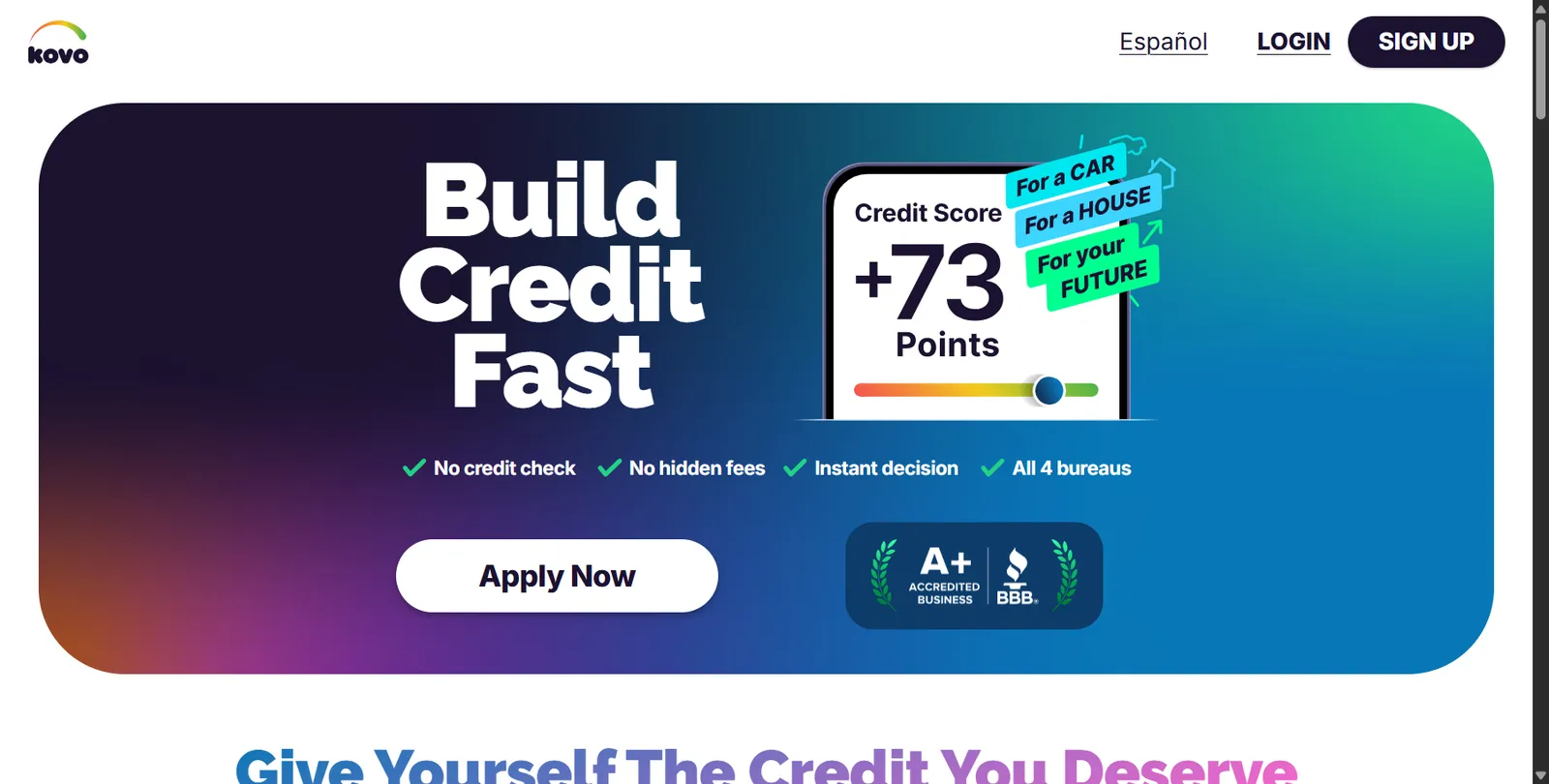
Why people look for Kovo alternatives
People compare Kovo with other credit builders for five plain reasons: price, payback, card access, eligibility and fit. Most buyers have one of these in mind. Naming yours first makes the rest of this article quicker to use.
Price. Kovo costs $10 a month (checked 22 November 2026). Some buyers want to see whether a plan exists at $5 a month. One does, and it is covered below.
Payback. Kovo describes its plan as buying tools and services on credit. It says there is no savings account attached and no cash payout at the end. Buyers who want money returned look at Self.
Card access. Kovo sells an account, not a card. Buyers who want a card to carry look at Yendo or Self.
Eligibility. Kovo needs a valid US Social Security number, an age of 18 or more, an instant background check and income qualification. Other providers use different checks, and the section on sign-up compares them.
Fit. Some buyers want the shortest plan, some want the longest reporting history, and some want rewards. Kovo has a clear answer for the last group.
What this means for you: decide which of the five reasons matters most to you. Then read the section for the option that answers it. For the wider market, see our roundup of the best credit builder apps and cards.
Kovo alternatives at a glance
Three options have enough published detail for a full comparison: Kikoff, Self and Yendo. Three more, Ava, CreditStrong and Dovly, get a short section because we hold only their own one-line descriptions. The table shows what each option is, what it costs and who it suits.
| Option | What it is | Price (checked 22 November 2026) | Main difference from Kovo | Suits |
|---|---|---|---|---|
| Kovo | Installment account that buys Kovo’s tools and services | $10 a month for 24 months | Four bureaus; rewards; 30-day refund window | Buyers who want one flat price and the widest reporting |
| Kikoff | Small credit account used to pay a monthly plan | $5, $20 or $35 a month, 12-month terms | Lowest entry price; three bureaus | Buyers who want the lowest monthly cost |
| Self | Credit builder account held in a bank certificate of deposit | $25 to $150 a month for 24 months | Money returned at the end, minus interest and fees | Buyers who want a payout and can pay $25 or more a month |
| Yendo | Mastercard backed by your vehicle | $40 annual fee, 29.88% to 35.88% APR | A real card with limits up to $10,000 | Car owners who want a card |
| Ava | Credit-building app | Not published in the pages we read | Builder card and savings product | Buyers who want to review its own offers |
| CreditStrong | Credit-building service | Not published in the pages we read | Describes itself as credit building for any goal | Buyers who want a further option to review |
| Dovly | AI credit app | Not published in the pages we read | Describes itself as a free AI credit app | Buyers who want a free app to review |
What this means for you: Kikoff, Self and Yendo are the three real comparisons. Each changes one big variable: price, payback or product type.
Kovo itself, for comparison
Kovo’s Installment Credit Account costs $10 a month for 24 months (checked 22 November 2026), and Kovo reports each payment to TransUnion, Equifax, Experian and Innovis. It says there is no hard credit pull to apply, no interest and no fees. This section sets out what that buys.
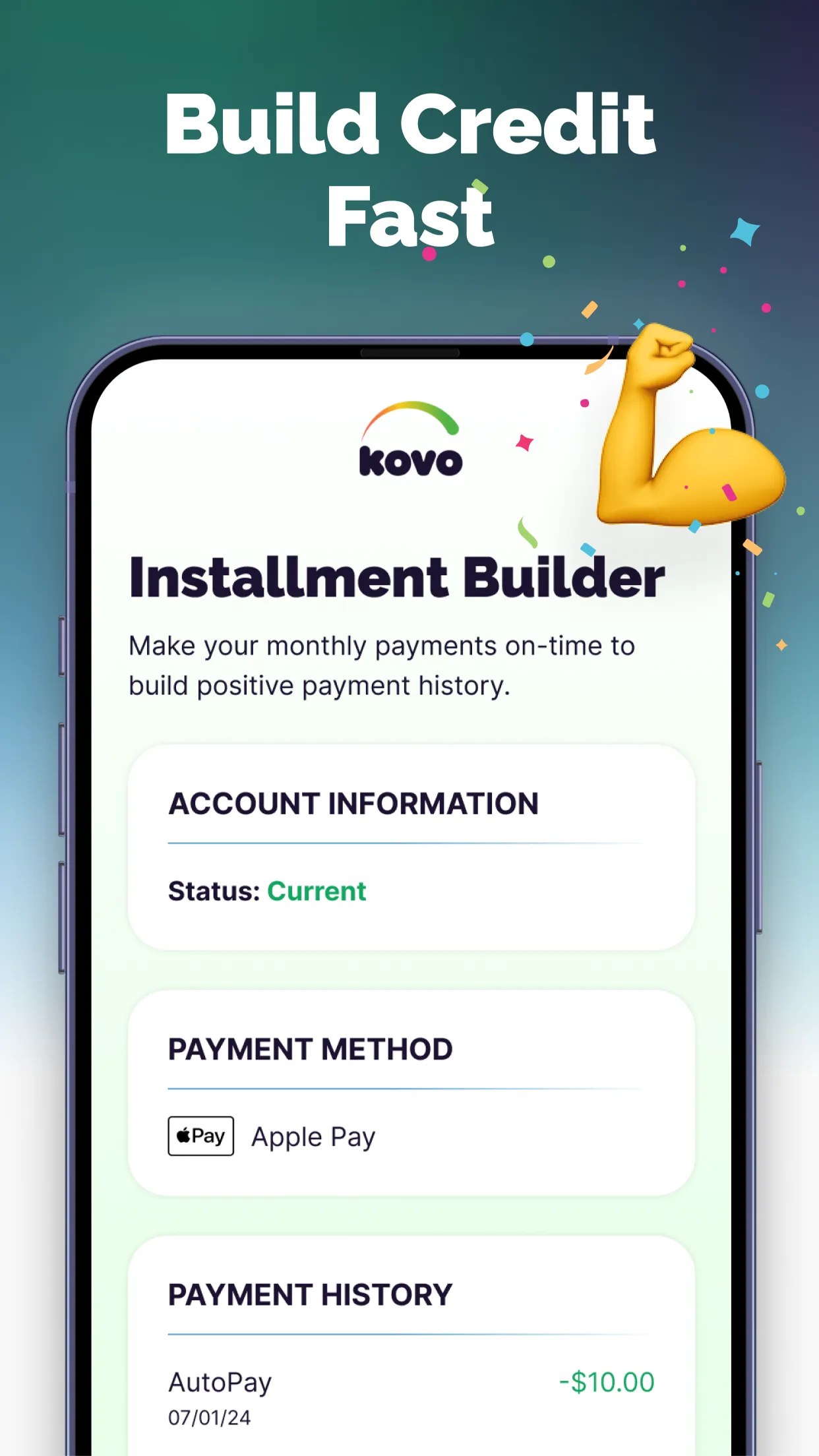
What you pay for. Kovo says the monthly payment buys “Kovo’s tools and services on credit.” Those include 24 months of ID monitoring, a FICO Score tracker and personal growth tools. The account is an installment contract, which means a fixed number of equal payments. It is not a loan that pays out money.
What it costs in total. Twenty-four payments of $10 come to $240. Kovo states the $240 figure for the plan, and it states 0% interest. It also lists no setup, membership, annual, late, failed-payment, processing or prepayment fees. You can pay off early with no penalty.
What you can add. After one on-time payment, Kovo says eligible customers can add credit boosts. One boost is a Revolving Credit Account with a $500 limit that you use at Kovo. It costs $10 more a month, so $20 in total, with $0 fees and 0% interest. The other is ID fraud insurance of up to $1,000,000, underwritten by American Bankers Insurance Company of Florida, an Assurant company.
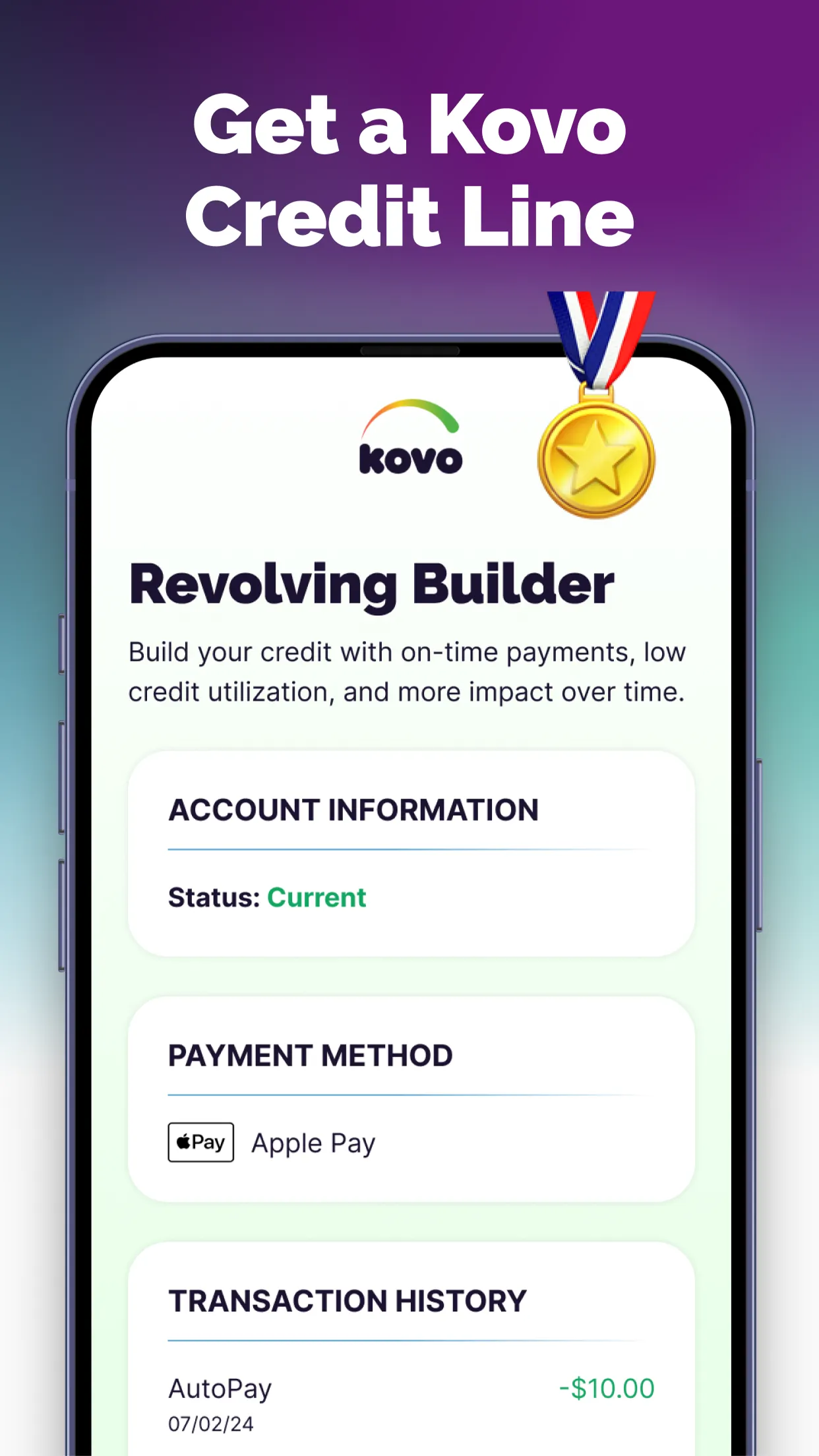
What buyers say. The Kovo app holds a 4.93 out of 5 rating from 14,279 ratings on the Apple App Store (read 22 November 2026). The listing is for “Kovo - Fast Credit Builder” from Kovo Inc., and the current version is dated 13 November 2026. The app is on iOS and Android.
Who is behind it. Kovo Inc. is a registered public benefit corporation, and its footer lists NMLS ID 2006784. Support is open at (855) 965-5686 and support@kovocredit.com. Kovo serves customers in all 50 states and the District of Columbia.
Kovo’s steps from sign-up to month 24
The Kovo journey has five steps, and each one is stated on its own pages. Knowing them in advance shows you what the 24 months look like.
- Apply on the web or in the app. You must be 18 or older and hold a valid US Social Security number. You certify that you are registering an account only for yourself. Kovo asks for a one-time check of your name, Social Security number and date of birth with the Social Security Administration, run through SentiLink.
- Get a decision. Kovo’s home page shows “Instant decision” and “No credit check”. The footnote explains that there is no hard pull and that approval follows instant background verification and income qualification. If you are declined, Kovo’s notice offers a statement of specific reasons when you ask within 60 days, delivered within 30 days.
- Make the first payment. Kovo says that by making your first payment you sign the Kovo Installment Credit Agreement electronically and choose auto-pay with that payment method. You can change the method later in your account.
- Pay for 24 months. Payments draft automatically, and Kovo reports on a monthly basis to the four bureaus. Kovo does not charge late fees. It says you cannot skip a payment.
- Use the extras. After one on-time payment, Kovo says credit boosts are open to eligible customers. After four on-time payments, active customers can use rewards.
Kovo says many customers need a few months before they see a change. That is an honest timeline for any credit builder, because the bureaus update on their own schedule.
What this means for you: you can plan Kovo month by month. The only decision after sign-up is whether to add the extras.
What this means for you: Kovo is a clear, flat-price plan with a 30-day refund window and the widest bureau reporting in this group. If those three points matter most, start with Kovo.
Kikoff: the lowest monthly price
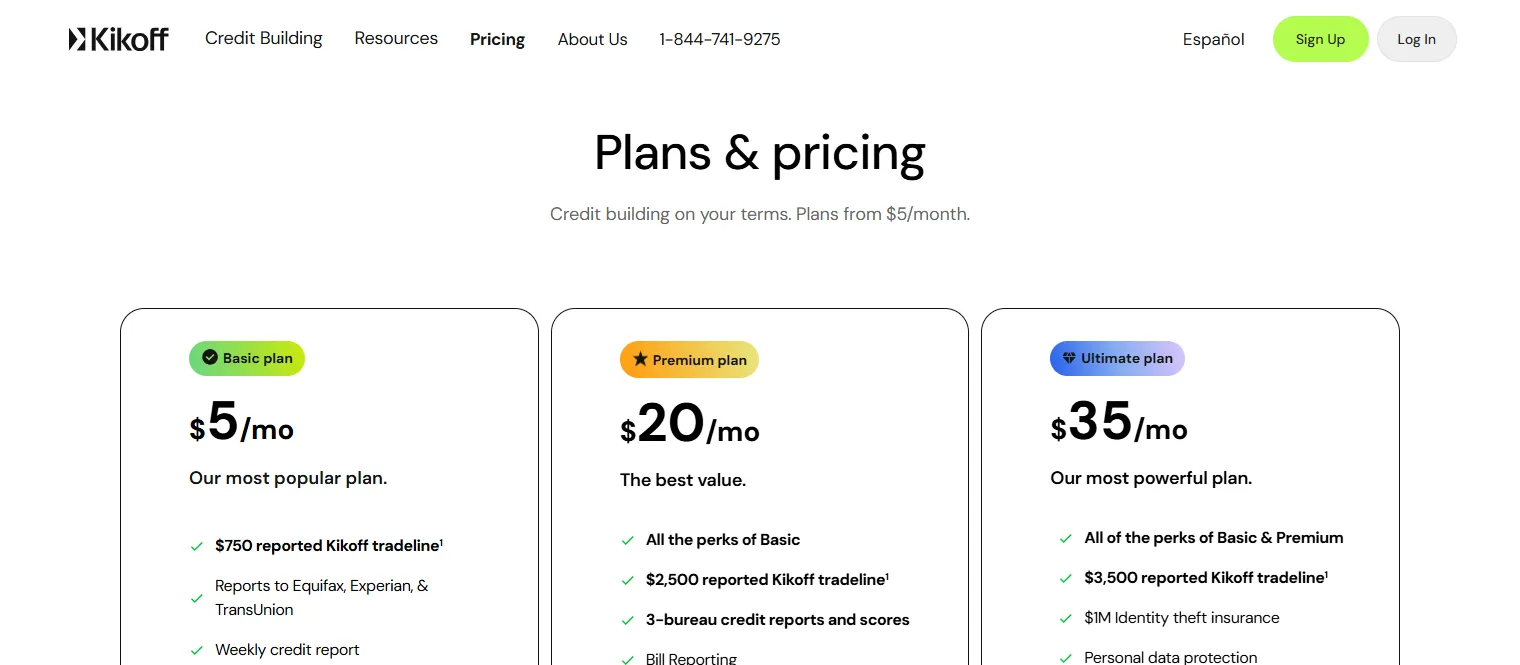
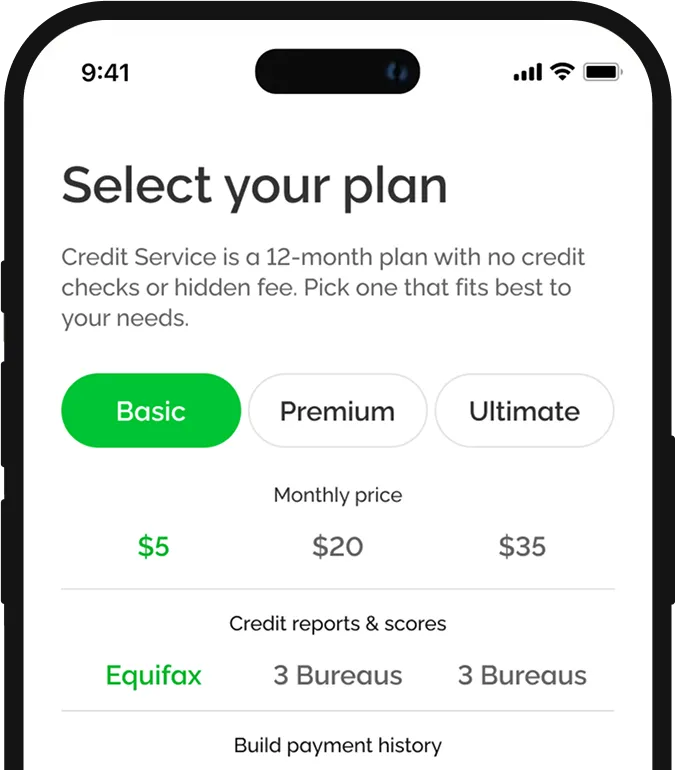
Kikoff is the strongest alternative on price: its Basic plan costs $5 a month (checked 22 November 2026). Premium is $20 a month and Ultimate is $35. Kikoff is the closest match to Kovo, because both sell a monthly plan through a small credit account.
How it works. You sign up with your email and verify your identity with a Social Security number or TIN. Kikoff says there are no hard credit checks to sign up. You then pick a plan, and Kikoff finances the plan cost through a small credit account called a tradeline. You repay it each month by debit card or bank account.
What each plan includes. The table shows the three plans as Kikoff lists them.
| Plan | Monthly price | Tradeline limit | Extras named on the pricing page |
|---|---|---|---|
| Basic | $5 | $750 | Reporting to Equifax, Experian and TransUnion; weekly credit report; rent reporting to Equifax and TransUnion |
| Premium | $20 | $2,500 | Everything in Basic; three-bureau reports and scores; spending tracking |
| Ultimate | $35 | $3,500 | Everything in Premium; $1M identity theft insurance; personal data protection |
Terms to know. Kikoff plans run for 12-month terms and renew each year unless you turn off auto-renew. Kikoff states the APR on the credit account as 0.00%, with no annual fee and no late payment fee. Its 45-day money-back guarantee is quoted in the policy section below.
What buyers say. Kikoff holds a 4.93 out of 5 rating from 284,673 ratings on the Apple App Store (read 22 November 2026). Kikoff Inc. is based in San Francisco, the lender on the credit account is Kikoff Lending, LLC, and its NMLS ID is 1930930. Kikoff has discontinued its Secured Card, so it is not a card option today.
Kikoff’s extras: rent, bills and disputes
Kikoff bundles extras that Kovo does not list, and they matter if you pay rent. These details come from Kikoff’s pricing and product pages, checked 22 November 2026.
- Rent reporting. Kikoff says it reports rent to Equifax and TransUnion each month, and Basic includes it. You link your bank account and submit your lease and landlord details.
- Past rent. You can report up to two years of earlier rent payments for a one-time $50.
- Bill reporting. Kikoff reports phone, electricity, natural gas and water payments to TransUnion monthly. The pricing page labels it for Premium and Ultimate users.
- Credit disputes. You can mail a dispute yourself for free, or let Kikoff handle the postage and paperwork on Premium and Ultimate.
- Marketplace. Kikoff says there is no fee to view or accept offers through its Marketplace.
What this means for you: if rent is your biggest monthly bill, Kikoff Basic gives you rent reporting at $5 a month. If you want a single plan with ID monitoring and rewards, Kovo is built for that.
Kikoff and Kovo side by side
Kikoff and Kovo are the most similar pair here, so a direct table helps. Kikoff figures come from its pricing page and terms, checked 22 November 2026.
| Point | Kovo | Kikoff |
|---|---|---|
| Entry price | $10 a month | $5 a month (Basic) |
| Plan length | 24 months, then it ends | 12-month terms that renew yearly |
| What you finance | Kovo’s tools and services | Your Kikoff plan |
| Credit limit shown | $500 on the optional Revolving add-on | $750, $2,500 or $3,500 by plan |
| Interest | 0% | 0.00% APR |
| Rent reporting | Not listed on the pages we read | Included with Basic, to Equifax and TransUnion |
| Past rent | Not listed | Up to 2 years of prior rent for a one-time $50 |
| Switching plans | Add or cancel the Revolving add-on by contacting support | Changing plan restarts the 12-month cycle |
| Refund window | 30 days | 45 days, once per person |
Kikoff’s terms set the minimum payment at the greater of the plan amount or 5% of your new balance. On Basic, the plan amount is $5. Kikoff’s support site says that changing plans restarts your 12-month cycle, so pick the plan you want before you start.
What this means for you: Kikoff gives you more plan choices and a lower first price. Kovo gives you a fixed finish line and one more bureau. Both are 0% interest, so the choice comes down to price against term.
What this means for you: if the monthly price is your top concern, Kikoff Basic costs half of Kovo. Kovo’s answer is a fixed 24-month plan with four-bureau reporting and a 30-day refund window. For a deeper look, read our Kikoff review.
Kikoff Basic starts at $5 a month and reports to Equifax, Experian and TransUnion. See current prices at Kikoff
Yendo: a car-backed credit card
Yendo is the right alternative if you want a card rather than a plan. The Yendo Auto Card is a Mastercard with limits from $450 to $10,000, a $40 annual fee and interest of 29.88% to 35.88% APR on any balance you carry (checked 22 November 2026). Your vehicle’s equity helps set the limit.
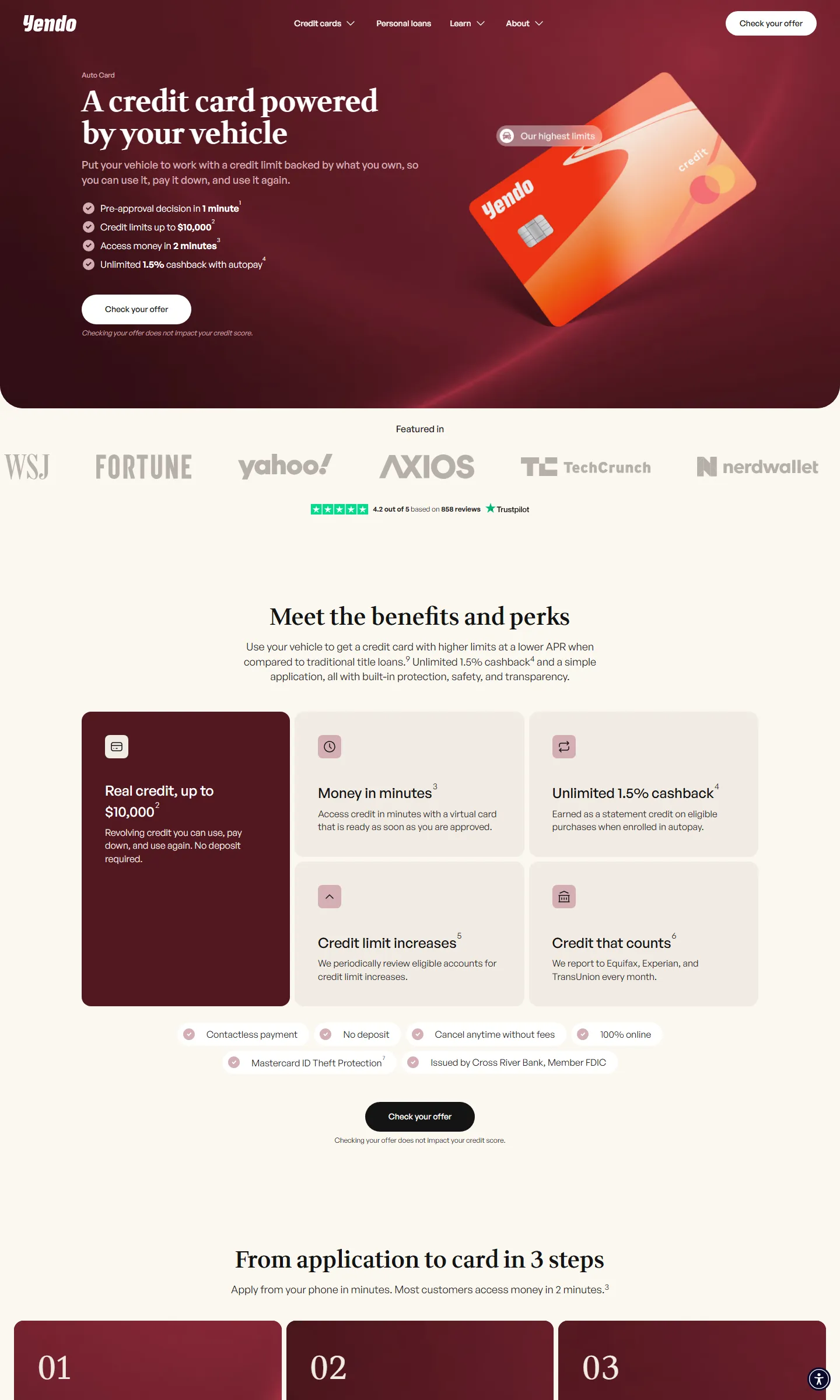
How it works. You tell Yendo about yourself and your vehicle, and you get a pre-approval decision in about a minute with no effect on your credit score. You then upload a photo of your government ID and a few photos of your vehicle. Yendo confirms with your state that the title is yours. If you accept the offer, Yendo runs a full credit check, and your virtual card is ready within minutes.
What you get. Yendo says the card offers unlimited 1.5% cashback with autopay and reports to Equifax, Experian and TransUnion each month. A physical card arrives in 3 to 7 days. The card is issued by Cross River Bank, Member FDIC. Yendo, Inc. holds NMLS number 2429415 and has operated since 2021 from Dallas, Texas.
The lien. A lien is a legal claim recorded on your car’s title. Yendo explains it in its own words:
“When you open a Yendo account, we record a lien on your car’s title. That’s a legal claim that stays in place while your account is open. It does not mean we own your vehicle or hold your keys.”
Source: Yendo Auto Card page
Yendo says you cannot sell the vehicle without settling the account first. Once your balance is zero, Yendo says it releases the lien within 10 business days.
What buyers say. Yendo holds a 4.85 out of 5 rating from 4,976 ratings on the Apple App Store (read 22 November 2026). The card is offered in the states Yendo serves, and the FAQ page at yendo.com/faqs lists the terms.

Yendo’s other products
Yendo sells four products besides the Auto Card, and one of them may suit you better. Prices below were checked on 22 November 2026.
| Product | What it is | Limit or amount | Fee and rate shown |
|---|---|---|---|
| Homeowner Card | Card secured by fixtures in your home | $1,000 to $2,000 | Annual fee from $40 to $69; 29.88% to 35.88% APR |
| Premier Rewards Mastercard | Unsecured card; no vehicle or home needed | $450 to $750 | $69 annual fee; 29.88% to 35.88% APR |
| Auto Card + Refinance | Refinances an existing auto loan and issues the card | Terms shown in the application | Same card terms; Yendo cites an average of $290 off the monthly payment |
| Personal Loan | Vehicle-secured loan paid to your bank account | $3,100 to $15,000 | Fixed 35.70% APR, 60 months, 5% origination fee |
Yendo’s loan example shows the cost plainly. A $10,000 loan with a $500 origination fee has 60 monthly payments of $341.44. Our arithmetic puts the total of those payments at $20,486.40. Yendo says there is no prepayment penalty, and you can repay early.
The Auto Card has one more feature worth knowing. After approval, eligible customers may access up to 40% of their credit limit, capped at $1,500, until the physical card arrives. Yendo says its Homeowner Card needs your name on the title, and a mortgage is fine.
What this means for you: Yendo is a lending product with interest, unlike Kovo’s flat plan. Choose it for a card or a loan, and choose Kovo if you only want to build payment history at a fixed cost.
What this means for you: Yendo costs more than Kovo each year and carries interest on balances, so it suits a different buyer. Choose it if you own a vehicle with equity and want a card. For more, read our Yendo review.
Yendo gives car owners a Mastercard with limits up to $10,000 and no deposit. Check eligibility at Yendo
Self: money back at the end of the plan
Self is the alternative for buyers who want money returned. Its Credit Builder Account is “a loan in a bank-held Certificate of Deposit (CD) that you pay off in monthly installments,” and the money comes back at the end, minus interest and fees. Self shows four options, all over 24 months (checked 22 November 2026).
| Monthly payment | APR | Finance charge | Total of payments | Payout after 24 months |
|---|---|---|---|---|
| $25 | 15.92% | $89 | $600 | $511 |
| $35 | 15.69% | $123 | $840 | $717 |
| $48 | 15.51% | $167 | $1,152 | $985 |
| $150 | 15.82% | $531 | $3,600 | $3,069 |
A certificate of deposit is a savings product held at a bank for a set time. Self says its accounts are held by Lead Bank, Sunrise Banks, N.A., or First Century Bank, N.A., each Member FDIC. Self Credit LLC holds NMLS ID 2167345. Self began in 2015 and says it has served 4 million builders.
Self describes the $35 option in its own words:
“Today, activate your account. Next month, pay $35 per month for 24 months. Each month you build credit history with all three credit bureaus. After 24 months, you’ve established credit history and you get $717.”
Source: Self pricing page
The card. Account holders can also apply for the Self Visa secured credit card. Self shows a minimum $100 deposit, a 27.74% variable APR, a $0 introductory annual fee in the first year and $25 after that.
How it compares. Self returns money, and Kovo does not. The cost is a higher monthly payment: the lowest Self option is $25 a month, against $10 for Kovo. Self pages mention a one-time administrative fee that may apply when you open the account.
What this means for you: if getting money back matters more than a low payment, Self is the better fit. Self does not sell through us, so check its own site for current terms. See our guide to how credit builder accounts work for the difference between a payout product and a service plan.
Self’s fees and missed-payment terms
Self publishes its fee terms on its support pages, so you can price them in advance. Self says you have up to 15 days after the due date before a late fee, and up to 30 days before a late or missed payment is reported to the bureaus. The late fee is 5% of your monthly payment, and a failed bank payment carries a $15 return fee. Paying by debit card carries a convenience charge, and any unpaid fees at the end come out of your payout.
Self also says you can pay your account off early and close it at any time. It notes that paying early builds less payment history, because fewer months are reported. An early closing fee of less than $1 may apply, depending on the account size (Self support page, 3 March 2026).
What this means for you: with Self, a $35 payment on time every month keeps the cost to the finance charge. Kovo’s flat plan has no late fee at all.
Ava, CreditStrong and Dovly in brief
Ava, CreditStrong and Dovly each describe themselves on their own sites, and that is all we hold. We list them so you can review each one, and we make no price comparison.
- Ava calls itself a “Credit Building App for Everyone.” Its site names the Ava Credit Builder Card, Ava Save and Build Credit, and Rent and Utility Reporting.
- CreditStrong calls itself “Credit Building for Any Goal.”
- Dovly calls itself “your free AI credit app” and describes the service as 100% free.
Kovo’s own app listing says Kovo has no connection with a list of named apps, including Kikoff, Self, Ava, Dovly, Credit Strong, StellarFi, Grow Credit and Credit Karma. That makes these names the ones shoppers set beside Kovo.
What this means for you: read each provider’s pricing and terms page before you pick one. Use the checklist near the end of this article to compare them with Kovo on equal terms.
What each option costs over 12 and 24 months
Over 24 months, Kovo’s plan costs $240, Kikoff Basic costs $120, and Self’s $35 option costs $840 in payments with $717 returned (checked 22 November 2026). The table shows the arithmetic. Totals are our sums from each provider’s published monthly price.
| Option | Monthly price | Paid after 12 months | Paid after 24 months | Notes |
|---|---|---|---|---|
| Kikoff Basic | $5 | $60 | $120 | Two 12-month terms; renews unless you turn off auto-renew |
| Kovo Installment | $10 | $120 | $240 | A 24-month plan; no interest, no fees |
| Kovo + Revolving add-on | $20 | $240 | $480 | If you keep both for 24 months as an example |
| Kikoff Premium | $20 | $240 | $480 | Two 12-month terms |
| Self lowest option | $25 | $300 | $600 | $511 returned after 24 months |
| Self $35 option | $35 | $420 | $840 | $717 returned after 24 months |
| Kikoff Ultimate | $35 | $420 | $840 | Two 12-month terms |
Here are three worked examples.
- If you choose Kovo for 24 months, you pay 24 times $10, which is $240.
- If you choose Self’s $35 option, you pay $840 and get $717 back. Self’s finance charge is $123.
- If you choose Yendo’s Auto Card for one year, the annual fee is $40. Interest applies only on a balance you carry, at 29.88% to 35.88% APR.
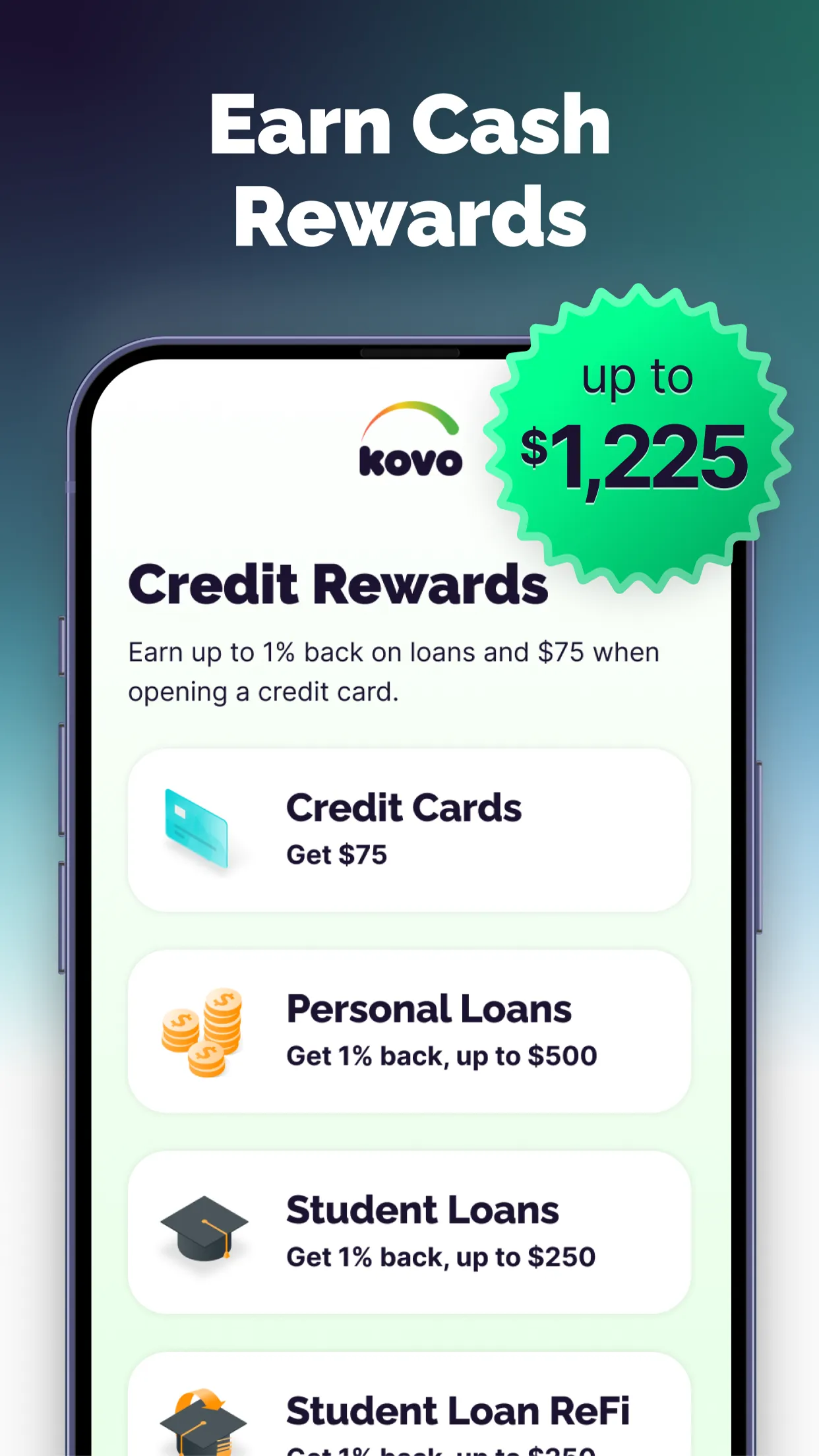
Kovo also runs a referral programme. It shows “$30 for each friend you refer” on its home page (checked 22 November 2026). Its rewards offer pays gift cards when you open partner loans or cards, and the caps add up to $1,225.
| Reward | Kovo’s stated cap |
|---|---|
| Personal loan issued (1% back) | Up to a $500 gift card |
| Student loan issued | Up to $250 |
| Student loan refinance issued | Up to $250 |
| Auto loan refinance issued | Up to $150 |
| Credit card issued | Up to a $75 gift card |
Kovo says rewards open up after four on-time payments. You open the partner account within 15 days of clicking the link, rewards are earned within 90 days of issuance, and each reward can be redeemed once per category.
What this means for you: Kikoff Basic is the cheapest plan on the list, and Kovo is the cheapest flat-price 24-month plan with rewards. Self costs more each month because part of what you pay comes back to you.
Refunds, cancellation and missed payments compared
Kovo gives you 30 days to ask for a free refund, and Kikoff gives you 45 days once per person. Kovo states its refund policy in its Help Center:
“If you’re looking to return your purchase with the Installment Credit Account for any reason, we’re here to help! We offer free refunds within 30 days. To initiate a return, please email support@kovocredit.com.”
Source: Kovo Help Center
To use the refund, email within the 30 days. After that, you cancel by contacting support, and Kovo says cancelling can have a negative impact on your credit score. The contract amount remains payable under Kovo’s terms. If you want to stop early, the no-prepayment-penalty rule lets you pay the balance off without a fee.
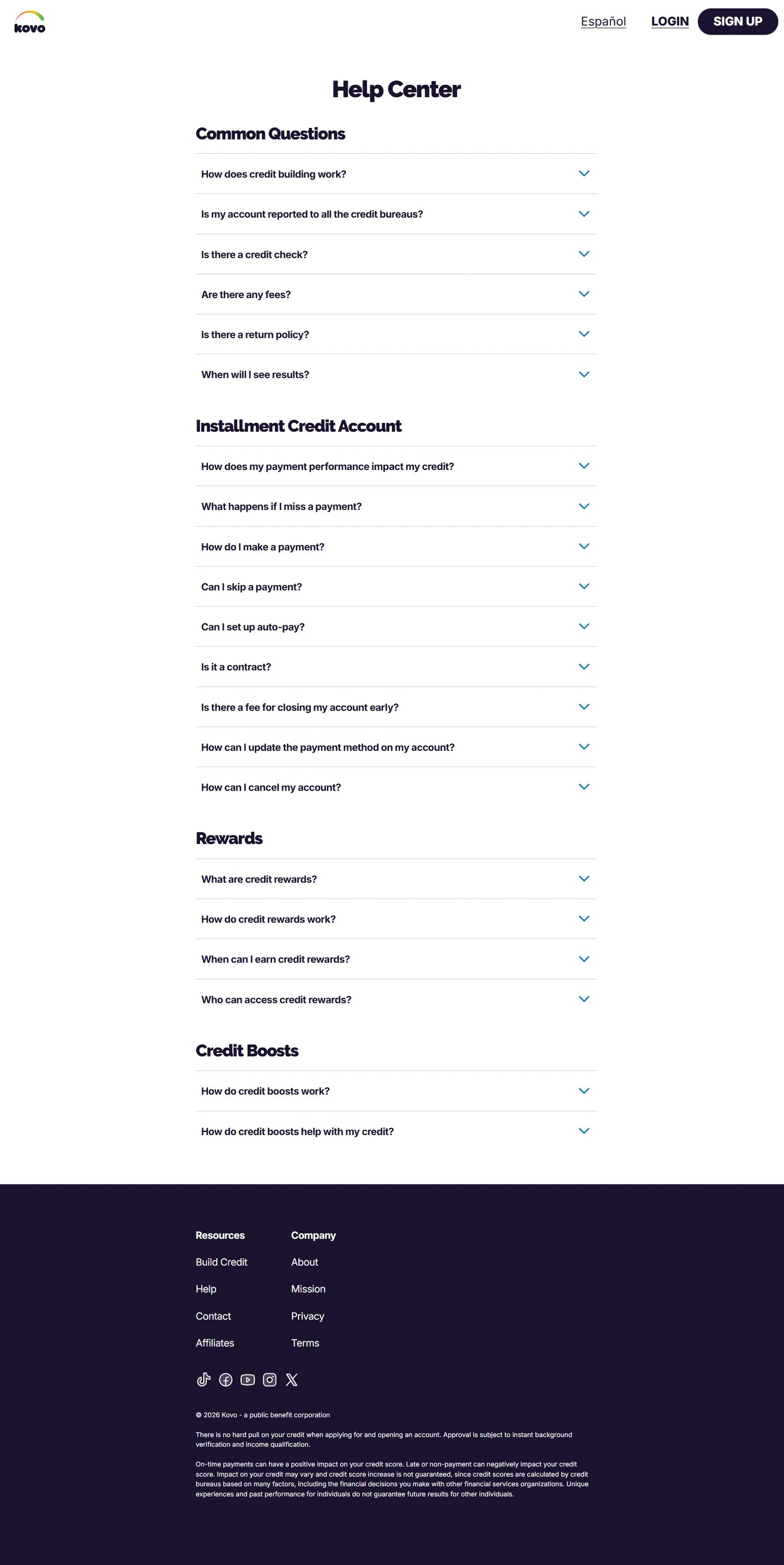
Kovo also says that it does not charge late fees, that you cannot skip a payment, and that if a past-due balance is unpaid after 30 days it must report payment performance to the bureaus. Set up your payment method with enough time before each draft, and the issue does not arise.
Kikoff states its guarantee as follows:
“…requires completing your cancellation of the Kikoff Credit Service and/or any other Kikoff store item(s) within 45 days, starting from the day of the first purchase … Guarantee is limited to up to one use per person.”
Source: Kikoff pricing page
| Policy | Kovo | Kikoff | Self | Yendo |
|---|---|---|---|---|
| Refund window | 30 days, by email | 45 days, once per person | Money returned at end of plan, minus interest and fees | Not applicable to a card |
| Early payoff | No penalty | Plan terms of 12 months | Allowed; closing early may carry a fee under $1 (Self support page, 3 March 2026) | Pay balance to zero to close |
| Late fee | None | None stated | Up to 5% of the payment after 15 days | Not published in the pages we read |
| Cancel by | Email to support | Email to support | In the account | Pay balance to zero, then call |
What this means for you: both Kovo and Kikoff give you a clear window to change your mind. Email inside the window, and read the policy page of the provider you pick before you pay.
Credit reporting and sign-up compared
Kovo reports to four bureaus, and Kikoff, Self and Yendo each report to three. Reporting is what makes these products useful for building a payment record, so the table sets out how each one does it.
| Feature | Kovo | Kikoff | Self | Yendo |
|---|---|---|---|---|
| Bureaus named | TransUnion, Equifax, Experian, Innovis | Equifax, Experian, TransUnion | Equifax, Experian, TransUnion | Equifax, Experian, TransUnion |
| When it reports | Monthly | Start of every month; up to 6 weeks to appear | Monthly, the day after the due date, from the first payment | Monthly |
| Hard credit pull to apply | None | None to sign up | None to open | Soft check first; full check if you accept |
| Other checks | Instant background check, income qualification, Social Security number | Identity check with SSN or TIN | Approval criteria apply | Vehicle title, ID, income |
Kovo says many customers need a few months before they see a change. No provider here promises a particular score, and your result depends on your whole credit file.
What this means for you: all four providers report monthly. Kovo covers one more bureau than the others, and you apply for it without a hard credit pull.
Who can apply
All four providers serve the United States, and each sets its own entry checks. The table sets them side by side, with details from each provider’s own pages.
| Point | Kovo | Kikoff | Self | Yendo |
|---|---|---|---|---|
| Where | All 50 states and the District of Columbia | All 50 states | Availability varies by option | 40 states stated; Personal Loan in 36 states |
| Age and ID | 18 or older; valid US Social Security number | Identity check with SSN or TIN; physically in the United States | Approval criteria apply | Government ID; vehicle registered to you in a served state |
| Income | Income qualification | Not stated in the pages we read | Card needs income and expense details | Income and ability to repay |
| What you hold | Nothing to pledge | Nothing to pledge | Money paid in builds the payout | A lien on your vehicle title |
What this means for you: Kovo needs no collateral and serves every state, which makes it the easiest to apply for from anywhere in the country.
If you want X, choose Y
Choose Kovo if you want one flat price, four-bureau reporting, rewards and a 30-day refund window. Choose an alternative when one of the points below matters more to you.
- If you want the lowest monthly price, choose Kikoff. Basic is $5 a month (checked 22 November 2026).
- If you want money back at the end, choose Self. Its $35 option returns $717 after 24 months.
- If you own a car and want a card, choose Yendo. Limits run from $450 to $10,000.
- If you want rent reporting, look at Kikoff. Its Basic plan lists rent reporting to Equifax and TransUnion.
- If you want ID monitoring in the same plan, choose Kovo. Kovo says its plan includes 24 months of ID monitoring.
- If you want rewards for opening partner accounts, choose Kovo. The stated caps total $1,225.
What this means for you: match your biggest need to one line above. If none of the other lines applies, Kovo is the all-round choice.
Four buyers, four choices
Four short examples show how the numbers work out. Each uses prices checked on 22 November 2026.
| Buyer | Main need | Our pick | Cost over 24 months |
|---|---|---|---|
| Maya | Lowest price | Kikoff Basic | $120 |
| Dev | A plan that ends | Kovo | $240 |
| Rosa | Money back | Self $35 option | $840 paid, $717 returned |
| Chris | A card | Yendo Auto Card | $40 annual fee a year, plus interest on any balance |
Maya has a tight budget and wants to start now. Kikoff Basic costs $60 for the first year, and Kovo costs $120 for its first 12 months. Maya starts with Kikoff Basic. If she later wants rewards and four bureaus, Kovo is the next step.
Dev wants a plan that ends in two years with no renewals. Kovo costs $240 for 24 months and then stops. Kikoff Basic costs $120 for two terms but renews unless he turns auto-renew off. Dev picks Kovo for the fixed finish.
Rosa wants money back and can pay $35 a month. Self’s $35 option costs $840 in payments and returns $717, so the finance charge is $123. Kovo costs $240 with no payout. Self’s figure leaves out any administrative fee, which Self may charge. Rosa picks Self for the payout.
Chris owns a car outright and wants a card. Yendo’s Auto Card has a $40 annual fee and limits from $450 to $10,000. Kovo does not sell a card. Chris picks Yendo.
What this means for you: the best option is the one that fits your budget, your timeline and the product type you want. Write your own version of these four examples with your numbers.
Who should buy Kovo, and who should look elsewhere
Kovo suits buyers who want a simple plan with a fixed price and clear terms. The list below shows who gets the most from it.
Who should buy Kovo
- You want a flat $10 a month for 24 months, with no interest and no fees.
- You want your payments reported to four bureaus, including Innovis.
- You want ID monitoring and a FICO Score tracker in the same plan.
- You want the option to add a $500 Revolving Credit Account for $10 more a month.
- You value a free refund within 30 days by email.
- You want rewards for partner accounts, up to $1,225 in total.
- You prefer a plan that ends after 24 months instead of renewing each year.
- You want an app on iOS and Android with a 4.93 rating from 14,279 ratings (Apple App Store, read 22 November 2026).
Who it is not for
- If you want money returned at the end, choose Self, which shows $717 back on its $35 option.
- If you want the lowest monthly price, choose Kikoff, where Basic is $5 a month.
- If you want a card to carry, choose Yendo if you own a car.
Kovo gives you four-bureau reporting, rewards and a 30-day refund window in one plan. See current prices at Kovo
What this means for you: if you fit the first list, Kovo is a good match. If you fit one of the three points in the second list, the named alternative is the better choice. Our Kovo review covers the product in more depth.
Who is behind each option
Each option names a company and a licence, and you can check them against the official records. The table collects what each provider publishes.
| Provider | Company | Licence or regulator detail | Partner named |
|---|---|---|---|
| Kovo | Kovo Inc., a public benefit corporation | NMLS ID 2006784 | ID fraud insurance underwritten by American Bankers Insurance Company of Florida, an Assurant company |
| Kikoff | Kikoff Inc., San Francisco; lender Kikoff Lending, LLC | NMLS ID 1930930; state licences listed on its licences page | Identity theft insurance with Assurant |
| Self | Self Financial, Inc.; Self Credit LLC | NMLS ID 2167345; state licences listed | Lead Bank, Sunrise Banks, N.A., or First Century Bank, N.A. |
| Yendo | Yendo, Inc.; Yendo Auto Servicing LLC | NMLS 2429415 and 2758990; state licences listed | Cards issued by Cross River Bank, Member FDIC |
Kovo also names SentiLink Verification Services Corp. as the service that checks your name, Social Security number and date of birth with the Social Security Administration. You can confirm Kovo’s NMLS ID on the contact page at kovocredit.com/contact. Kovo describes its mission and coverage on its about page.
For more on Kovo’s background, see our guide to whether Kovo is legit.
What this means for you: all four providers publish a company name and a licence number. Check the NMLS number on the official consumer access site before you pay any provider.
How to compare credit-building offers yourself
Compare any credit builder on the same six points, in this order. A short checklist keeps the choice simple, and you can apply it to any provider, including ones we do not cover.
- Total cost. Multiply the monthly price by the number of months. Add any one-time fee. Subtract any money returned at the end.
- Term. Check whether the plan ends or renews. Kovo ends after 24 months, and Kikoff renews yearly unless you turn it off.
- Reporting. Confirm which bureaus receive your payments and how often.
- Payback. Find out whether you get money back at the end, and how much.
- Refund window. Note the days you have to change your mind, and how to ask.
- Company. Look up the company name and NMLS number on the official record.
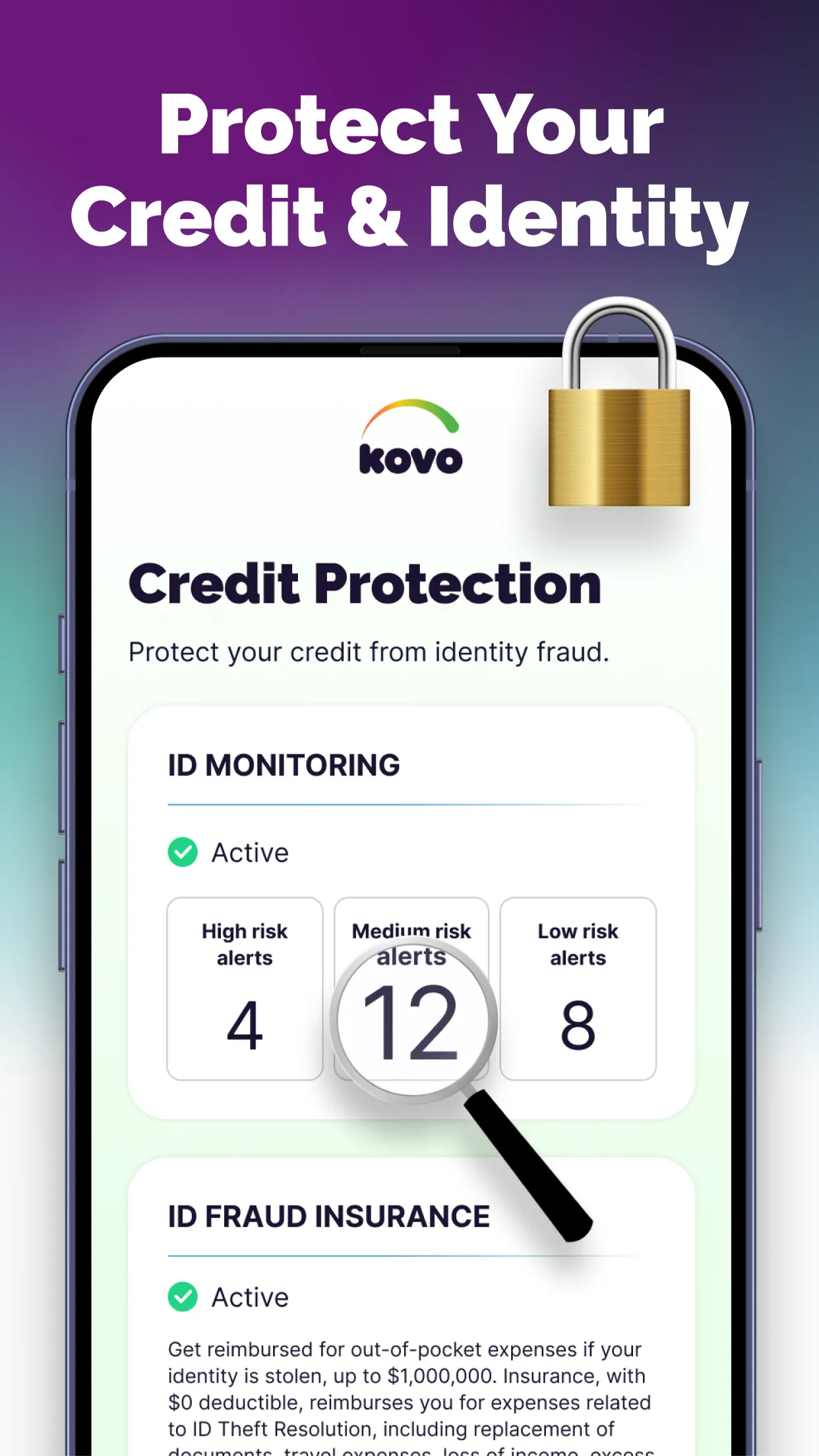
Add a seventh point if you need extras. Kovo lists ID monitoring and ID fraud insurance, Kikoff lists rent reporting and identity theft insurance on higher plans, and Yendo lists Mastercard ID Theft Protection. Price each extra before you count it as value.
What this means for you: run your two favorite options through the six points, and write the 24-month cost for each. The answer is usually clear within five minutes.
Our recommendation
Kovo is our recommendation for most buyers who want a simple, flat-price credit builder with the widest reporting. It costs $10 a month for 24 months, $240 in total (checked 22 November 2026), with no interest, no fees, a 30-day refund window and reporting to four bureaus.
Choose Kikoff if you want the lowest monthly price, starting at $5 a month. Choose Self if you want money returned at the end, and you can pay $25 or more a month. Choose Yendo if you own a car and want a card. Read the policy page of any provider before you pay.
You can compare more options in our roundup of the best credit builder apps, and read about cancellation terms in our guide to how to cancel Kovo and get refunds. For the steps after sign-up, see how Kovo works.
Kovo is the simplest all-round credit builder in this comparison: one price, four bureaus, 30 days to decide. See current prices at Kovo
This article is general information, not financial advice. Terms, rates and fees change; confirm them on the provider’s site before you apply.
Frequently asked questions
What are the best Kovo alternatives?
The closest options are Kikoff, Self and Yendo. Kikoff has the lowest entry price at $5 a month. Self returns money at the end of its 24-month plan, minus interest and fees. Yendo is a Mastercard backed by your vehicle. Each one changes one big variable, so the right choice depends on what you want from the account.
Is Kovo cheaper than Kikoff?
It depends on the plan. Kikoff's Basic plan costs $5 a month and its Premium plan $20, while Kovo's Installment Credit Account costs $10 a month for 24 months (checked 22 November 2026). Over 24 months that is $240 at Kovo against $120 for Kikoff Basic, if you keep Basic for two 12-month terms.
Does Kovo report to more credit bureaus than its rivals?
Kovo says it reports to four bureaus: TransUnion, Equifax, Experian and Innovis. The Kikoff, Self and Yendo pages we read name three: Equifax, Experian and TransUnion. Kovo makes no claim that lenders favor the fourth bureau, so choose on price and terms, and treat bureau count as one factor among several.
Can I get my money back from a credit builder?
It depends on the product. Self returns the money held in its account at the end of the term, minus interest and fees. Kovo and Kikoff do not pay out at the end, because you buy a service. Kovo offers free refunds within 30 days and Kikoff offers a 45-day money-back guarantee, each started by contacting support.
Do these credit builders run a hard credit check?
Kovo, Kikoff and Self each say you can open an account without a hard credit pull. Kovo adds an instant background check and income qualification. Yendo's pre-approval is a soft check with no effect on your score, and a full credit check follows only if you accept the offer.
Which Kovo alternative gives me a real credit card?
Yendo and Self both sell cards. The Yendo Auto Card is backed by your vehicle, has limits from $450 to $10,000 and carries a $40 annual fee. The Self Visa is secured by a deposit of at least $100. Kikoff's secured card has been discontinued, and Kovo sells an account rather than a card.
Can Kovo or its alternatives promise a higher credit score?
No. None of these providers promise a particular score, and Kovo says on its own site that a score increase is not guaranteed. Reporting on-time payments gives the bureaus new payment history, and the effect on your score depends on your full file. Check each provider's terms before you sign up.
How long do Kovo and Kikoff plans last?
Kovo's Installment Credit Account runs 24 months at $10 a month. Kikoff plans run for 12-month terms and renew each year unless you turn off auto-renew. Self's Credit Builder Account runs 24 months in all four options shown. Yendo is a revolving card with no fixed term, which you can close after paying the balance to zero.
Are Kovo and Kikoff the same kind of product?
They are similar. Both sell a monthly plan that you pay for through a small credit account, and both report your payments to the bureaus. Kovo's payment buys its tools and services on credit, including ID monitoring and a FICO score tracker. Kikoff's credit account is used only to pay for your Kikoff plan.
Where can I compare more credit builders?
Our roundup of the best credit builder apps and cards sets out Kikoff, Kovo, Self and Yendo with dated prices. Our guide to how credit builder accounts work explains the main product types in plain words. Both are linked in this article, and each one carries the date its figures were checked.
Sources
Pages we read for this article, checked 22 November 2026.
About the editor
Ruth Calloway, money editor
Ruth covers consumer finance products and reads the disclosures, fee tables and terms that most people skip.